Hiển thị các bài đăng có nhãn flights from australia to vietnam. Hiển thị tất cả bài đăng

Booking flights from Australia to Vietnam : Exploring Vietnam culture with Full moon Festival

How to book flights from Australia to Vietnam?


Vietnam Airlines, you can book flights from Australia to Vietnam at www.VietnamAirlinesTickets.com run many flights from Australia to Ha Noi and Ho Chi Minh City. Flights to Vietnam are at their most expensive during Christmas, New Year and Lunar New year. Airlines often has promotion in summer cho domestic flights & international flights.

 How many are there Vietnam culture festivals?


Annually Vietnam have many festival that you could explore  : Tet Holiday, Mid- Autumn Moon Festival, Hung King's Festival, Hue's Festivel, Da Lat's Festival,

Booking flights from Australia to Vietnam : Exploring Vietnam culture with Full moon Festival

How to book flights from Australia to Vietnam?


Vietnam Airlines, you can book flights from Australia to Vietnam at www.VietnamAirlinesTickets.com run many flights from Australia to Ha Noi and Ho Chi Minh City. Flights to Vietnam are at their most expensive during Christmas, New Year and Lunar New year. Airlines often has promotion in summer cho domestic flights & international flights.

 How many are there Vietnam culture festivals?


Annually Vietnam have many festival that you could explore  : Tet Holiday, Mid- Autumn Moon Festival, Hung King's Festival, Hue's Festivel, Da Lat's Festival,

Flights from Australia to Vietnam (Sydney to Vietnam)

Vibrant Vietnam is rapidly gaining popularity with those looking for somewhere that little bit different. If you want a taste of the exotic, why not consider Vietnam for your next trip? With great priced flights from Australia to Vietnam (Sydney to Vietnam), wot are you waiting for?

From the cool mountains of Sapa to the gorgeous beaches of Dalat, and from the lively and bustling cities of Hanoi and Ho Chi Minh City to the stunning Halong Bay, with such a terrific selection of things to do and see, Vietnam really can be everyone’s cup of tea!

Renowned for incredible diving hot spots, adventure seekers will not be disappointed. Fashionistas will be impressed with the high quality and really reasonably priced tailoring available in Hoi An. Whether you are looking for a bespoke business suit, some great fitting casual wear, a tailor made outfit for a special occasion, or other fabulous clothing, you can enjoy luxury for less as you are specially measured for that perfect fit.
flights from australia to Vietnam
Visit ancient and historic sites such as temples and grand palaces, lean more about the war that ripped the country in two, watch a novel and traditional water puppet show, cycle through lush, green rice paddies, and shop in lively marketplaces. Locally produced beer is incredibly cheap, and when it comes to food, you mustn’t miss out on the famous Vietnamese pho and French-inspired breads and pastries.

Book your flight from Austalia to Vietnam today and discover why so many people fall in love with this fascinating land!

Cheap Flights from Australia to Vietnam - SYD to SGN

Popular Flights from Australia to Vietnam


  •     Airfare for flights from Australia to Vietnam on Singapore from Australia$871 round trip
  •     Airfare for flights from Australia to Vietnam on Qantas from Australia$871 round trip
  •     Airfare for flights from Australia to Vietnam on China S from Australia$872 round trip
  •     Airfare for flights from Australia to Vietnam on Virgin Australia from Australia$876 round trip
  •     Airfare for flights from Australia to Vietnam on China from Australia$940 round trip

Did You Know?

flights from australia to vietnam

  • 154 flights per week flights from Australia to Vietnam: fly out of Sydney, Australia connecting to Ho Chi Minh City, Vietnam
  • The largest aircraft operated by Japan flying between Sydney, Australia and Ho Chi Minh City, Vietnam is a 777 with 328 seats.

Extra Flights from Australia to Vietnam & Vice Versa

There are up to 3,300 extra seats each week for passengers travelling on flights from Australia to Vietnam & vice versa under a new Memorandum of Understanding (MOU) that the Australian Government has signed with the Government of the Socialist Republic of Vietnam.

The extra seats will boost two-way tourism by giving people more opportunities to travel on flights from Australia to Vietnam and vice versa.The agreement secures a number of benefits for travellers and the aviation and tourism industries. Air carriers from both countries can now:

  • fly 14 services a week or about 4,200 seats to and from major Australian gateway destinations of Sydney, Melbourne, Brisbane and Perth - an increase of about 1,200;
  • fly seven services a week or about 2,100 seats to and from these destinations if the flights stop over at regional Australian airports such as Adelaide, Darwin or Cairns;
  • stop over in Hong Kong to drop off and pick up passengers who book flights from Australia to Vietnam and vice versa.


The signing of this memorandum finalises negotiations which began in 2010 and underscores Australia’s record of cooperation with Vietnam. 

Flights from Australia to Vietnam: Air Australia Applies for Operating Permission

AIR Australia is seeking permission to operate flights from Australia to Vietnam.

The Brisbane-based airline has asked the International Air Services Commission for permission to operate four flights from Australia to Vietnam per week from Sydney, Melbourne, Perth and Brisbane, using Avalon Airport, near Geelong, in its application.

The carrier wants to start operating flights from Australia to Vietnam from March 2012 and said in its application that capacity would be fully utilised by February, 2013.


Flights to Vietnam from Sydney & Other Cities of Australia

There are currently many airlines operating flights to Vietnam from Sydney & Other Cities of Australia. The main ports of entry for air travel are Tan Son Nhat airport (SGN) in Ho Chi Minh City or Noi Bai Airport (HAN) in Hanoi. The number of direct routes from Australia to Vietnam are still very limited and most flights departing from this region to Vietnam involve a transit in Hongkong, Bangkok, Seoul, Tokyo or Singapore.


flight to vietnam from sydney
flights to vietnam from sydney

Flights to Vietnam from Sydney & Other Cities of Australia

Daily flights to Vietnam from Sydney, Canberra or Melbourne to Ho Chi Minh City connect in Taipei, Kuala Lumpur, Darwin or Bangkok.  Flights from Wellington or Auckland have stopovers in Kuala Lumpur.  Quantas and Vietnam Airlines operate direct flights between Ho Chi Minh City and Sydney though the price can be 30% higher compared with other routes. Other airlines that run the route between Vietnam and Oceania include Cathay Pacific, Thai Airways, China Southern, Singapore Airlines, to name a few.

Best Time to Book Flights Hanoi

Hanoi, the capital of Vietnam, is preferred over the more crowded locations such as Ho Chi Minh City in the south, because of its charm and original culture and historical influence. Travelers are advised to book flights Hanoi when the climate is best: in early spring or throughout autumn & stay away from the hot and humid weather and summer rainy periods. As the year ends, the city becomes most crowded and hotel prices soar.

flight hanoi
flights Hanoi


I booked flights Hanoi to visit Hanoi during Tet, the Vietnamese New Year celebration; the biggest holiday of the entire year. Tradition states that the days prior to the holiday, people are to bring special gifts to the individuals they wish to impress. Since there is a high demand for specialties, shops pop up all over town. City streets are filled with vendors selling hoa doa; peach trees that equal the sentiment of an American Christmas tree. It is a truly exciting time and one I’ll not forget in a long time!

Flights Hanoi: 48 hours in Hanoi

Direct flights Hanoi mean you can now visit Hanoi for a long weekend (just about). Our writer takes a jet-lagged, surreal tour of Vietnam's colourful capital

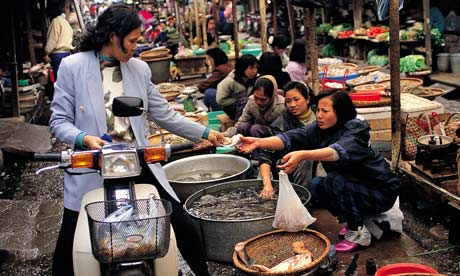
Hanoi's fish market
Hanoi's fish market. Photograph: Alamy

The waiter was missing two fingers. The other two and his thumb were squeezed tightly around the throat of a bamboo snake, writhing and snapping and trying to relieve the waiter of one of his remaining digits.

With his other hand, he pulled a knife from his back pocket and made a delicate incision in the soft flesh of the snake's underbelly, into which he stuck his finger and ripped out its heart, plonking it into a small glass of rice wine in front of me. The wine blushed crimson.

He held the glass in front of my face. The heart was still pumping, sending little ripples through the liquid.

"Drink. Quickly," he said. "As guest, unlucky if you don't…"

I had arrived in Hanoi just a few hours earlier, having been invited on the inaugural direct flights Hanoi from the UK, which cuts many hours off the travelling time.

It had seemed the perfect opportunity to see if Hanoi could work as a long-weekend destination. After a sleepless 11-hour overnight flight, with a seven-hour time difference and feeling utterly bewildered in the fog of jet lag, it was already looking like one of my stupider ideas.

"You here just for three days," Thone, my guide, had said at the airport. "Crazy. What do you want to see?" "Everything," I'd said, which was my second mistake.

And so there I was, surrounded by Hanoi families enjoying their reptilian repasts, swallowing the still-beating heart of a snake, followed by snake intestine and kidney stir-fry, sticky rice in snake bile, and snake-head crème caramel. As I washed it all down with a bottle of rice wine containing a cobra's penis, I had a vision of animal-rights activists and environmentalists in the UK slugging it out for the right to rip my heart out.

We walked back towards downtown Hanoi on the narrow walkway across the mile-long Long Bien iron-truss bridge, high above the Song Hong, or Red River – from which the city gets its name. Hanoi means "the city in the bend of the river".

It has six million people and 6m mopeds, and it seemed like they were all out riding across the bridge, carrying just about every load imaginable, forcing us to fling ourselves against the railings to avoid decapitation by a bed frame or getting knocked over the side by a wardrobe. The never-ending tide, combined with the trains that trundled across, made the whole structure bounce and pulse as if it was alive.

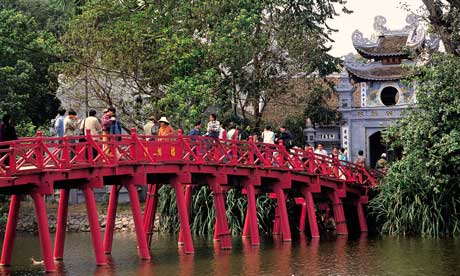
Vietnam, Hanoi
Huc Bridge, which spans Hoan Kiem lake. Photograph: Hemis/Alamy

Just off the bridge, we entered the labyrinthine streets and alleyways of the Old Quarter, Hanoi's beating heart of commerce, as old as the city itself. Beneath a canopy of banyan trees dripping with Spanish moss, the pavements were full of people washing clothes, men welding metal, and makeshift barber shops. This made it necessary to walk in the road, amid the moped madness. Thone had perfected the art of negotiating the mopeds, communicating where the tide should part by wafting his hand in some divine way, like Moses.

Women in coolie hats weaved past bearing vast loads of cassavas and dried fish in baskets at either end of a flexing bamboo yoke, tiptoeing under the strain as if wearing shoes two sizes too small. If there was ever a place to feed western fantasies of the Orient, here it was.

Every street has a designated purpose, the legacy of the 13th-century guildsmen who divided up the Old Quarter into 36 areas, so the prefix "Hang" on street signs means "merchandise". We turned into Hang Ma, where the Hanoians go for their paper votive offerings to be burned on the anniversary of the death of a loved one. The votives are a reflection of their interests, so there were paper cars, stereos and life-sized bicycles.

Most shops had altars with burning incense and flowers – bought on the 1st and 15th of the Chinese lunar month for luck – at their entrance, Casablanca lilies and orchids: Vietnam is blessed with more than 1,000 varieties.

On to Hang Dong (copper bells and gongs), Hang Cot (bamboo) and Hang Non (hats). It was like the ultimate department store. On Thouc Bac (herbal medicine), the shops were crammed with lotus seeds, huge cinnamon sticks and jars of rice wine full of snakes and scorpions. The sweet smell was quite overpowering.

I was flagging now, seeing all of this as if through frosted glass. Thone took me to my hotel. I'd just dozed off when the speakers that line every Hanoi street started up, like the call of mosques, but instead of muezzin inviting the faithful to prayer, it was the government reminding citizens to pay their taxes. That stopped after an hour, after which the couple next door started having very noisy sex. At 5am the street speakers kicked off again. Then my phone rang.

"Time to go, Mike," said Thone, "no time to waste."

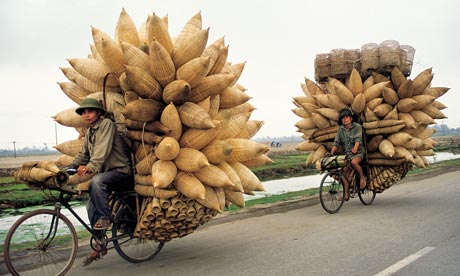
Weavers with conical fish baskets
Weavers with conical fish baskets. Photograph: Alamy

In the grey dawn light we arrived at the Brobdingnagian vastness of Ba Dinh Square, where elderly figures exercised, flapping like butterflies in time to staccato instructions from a woman at the front. A shrill flurry of whistles, then authoritarian martial music boomed out from unseen speakers and a column of soldiers appeared, marching with furious intent in uniforms as white as virgin snow. They raised Vietnam's flag in silent reverence.

"Now you go and see Uncle Ho," said Thone, pointing to a huge colonnaded building. "He's just back from Moscow for his annual touch-up, so should be looking good."

As I shuffled in, joining a snaking queue of Vietnamese, an angry-looking soldier told me to take my hands out of my pockets, and the one 10 yards along not to hold my hands behind my back. I felt like I was going to see the headmaster, which in a way I was, because suddenly I was staring at the yellow, goateed corpse of Ho Chi Minh – Marxist-Leninist revolutionary, revered father of modern Vietnam, liberator from French colonialism, who died in 1969 – lying in his glass sarcophagus. I looked around at the Vietnamese, some wiping away tears, some staring in awe, and felt like an interloper at a moment of private grief.

In front of Ho Chi Minh's house, we walked around a carp lake shaded by mango trees, which the Vietnamese seemed to appreciate, seeing as they were all applauding it. Thone explained that Uncle Ho is said to have called the fish to be fed by clapping his hands and thus visitors now do the same. I clapped. No fish came, but a boy next to me smiled.

We stopped at a backstreet restaurant for pho bo, Hanoi's delicious staple – a salty soup of rice noodles and beef, garnished with ginger and lime and fiery chillies. We ate it with our knees up around our shoulders, sitting on the Wendy House plastic stools that every Hanoi café seems to favour, and which Thone couldn't explain.

After lunch we walked through the five courtyards of the Temple of Literature, Vietnam's first university, founded in 1076, a maze of beautiful formal gardens framed by fig trees, with low-slung pagodas with sinuous roofs. Young women in dazzling white and yellow silk ao dai dresses, embroidered with delicate silk roses and gerberas, prayed to a statue of Confucius for good exam marks.

In the middle of the city we walked around the most famous of Hanoi's many lakes, Hoan Kiem, which glittered like mercury under the sun. We weaved through games of badminton being played on makeshift courts on the pavements, the nets strung between flame trees festooned with red paper lanterns that hang like pendulous fruit.

If the morning had been full of light, the afternoon was darker. We visited the Hoa Lo prison, nicknamed the "Hanoi Hilton" by US air crew downed during their ferocious bombing of the city. One room was full of dummies of emaciated Vietnamese prisoners shackled by the French colonial authorities to their beds, the next contained the prison's grisly original iron guillotine. Then there were photographs of smiling GIs playing table tennis, which illustrated either a more benign captivity or the fact that it's the victors who write the history books.

Close by, at Dii Vet, an Aladdin's cave of a shop selling exquisite lacquerware and hand-embroidered silk tapestries, a smiling boy held up a beautiful scene of Halong Bay for me to inspect. He had seven fingers on each hand and smooth skin on the side of his face where an ear should have been. Other young people sat at looms, their fingers weaving, but staring ahead with lifeless eyes.

"Deaf and dumb," said Thone. These were some of the five million people still hereditarily affected by the Agent Orange dropped by the US. "They make these things here and send the money back to their villages."

After another sleepless night for me, Thone turned up on his moped and patted the back seat. "Now you get to see Hanoi properly!"

We flew down a street lined with coffins and a street packed with shoes, along wide boulevards flanked by giant rosewood trees, around lakes and past temples, around us continued the intricate ballet of mopeds, carrying caged parrots, or hidden under mountains of flowers so they looked like carnival floats. We passed mustard-coloured French belle-epoque mansions, the magnificent French colonial opera house, and a huge statue of Lenin, and rode along a street of restaurants where glazed dogs lay on their backs in display cases as if waiting for a tummy tickle. I felt like I had never been to such a beautiful, strange, crazy place.

On the way to the airport, Thone dropped me off at the Thang Long, a water puppet show that has its 11th-century origins in the paddy fields of the countryside and which can be best described as Punch and Judy in a pool. I watched a succession of surreal giant fish, fire-breathing dragons and mutant mushrooms do battle with villagers, accompanied by a man playing the single-string dan bau, or zither, and a woman with the most haunting voice I've ever heard.

Fourteen sleepless hours later, I would be back in my flat in London, looking at two giant water puppets and a snake's penis in a bottle of rice wine, the only proof that this was no half-remembered dream.

Flights Vietnam: Getting around

You have already booked flights Vietnam? How can you get around this beautiful country?

Boat

Vietnam has an enormous number of rivers that are at least partly navigable, but the most important by far is the Mekong River and its tributaries. Scenic day trips by boat are possible on rivers in Hoi An, Danang, Hué, Tam Coc and even HCMC, but only in the Mekong Delta are boats used as a practical means of transport.

fare to vietnam
Flights Vietnam

Boat trips are also possible on the sea. Cruising the islands of Halong Bay is a must for all visitors to north Vietnam. In the south, a trip to the islands off the coast of Nha Trang is popular.
In some parts of Vietnam, particularly the Mekong Delta, there are frequent ferry crossings. Don’t stand between parked vehicles on the ferry as they can roll and you could wind up as the meat in the sandwich.

Hitching

Hitching is never entirely safe in any country in the world, and we don’t recommend it. Travellers who decide to hitch should understand that they are taking a potentially serious risk. People who do choose to hitch will be safer if they travel in pairs and let someone know where they are planning to go.

Car & motorcycle

The relative affordability of vehicle hire makes the latter a popular option. Having your own set of wheels gives you maximum flexibility to visit remote regions and stop when and where you please.

Hire

The major considerations are safety, the mechanical condition of the vehicle, reliability of the rental agency and your budget. Don’t think about driving a car yourself in Vietnam (a motorbike is challenging enough) and moreover, hire charges for the car include a driver.

Motorbike

Motorbikes can be rented from cafés, hotels, motorbike shops and travel agencies. If you don’t fancy self-drive, there are plenty of local drivers willing to act as a chauffeur and guide for around US$6 to US$10 per day.

fly to vietnam
Flights Vietnam

Renting a 100cc moped is cheap from around US$5 per day, usually with unlimited mileage. To tackle the mountains of the north, it is best to go with a Minsk. The ‘mule of the mountains’, these sturdy Russian steeds don’t look up to much, but they are designed to get you through, or over, anything. They are available for rent from specialist shops in Hanoi. For the ultimate experience in mountains of the north, consider joining a motorbike tour to discover the secret backroads.
Most places will ask to keep your passport until you return the bike. Try and sign some sort of agreement – preferably in a language you understand – clearly stating what you are renting, how much it costs, the extent of compensation and so on.
Insurance
If you are travelling in a tourist vehicle with a driver, then it is almost guaranteed to be insured. When it comes to motorbikes, many rental bikes are not insured and you will have to sign a contract agreeing to a valuation for the bike if it is stolen. Make sure you have a strong lock and always leave it in guarded parking where available.
Do not even consider renting a motorbike if you are daft enough to be travelling in Vietnam without insurance. The cost of treating serious injuries can be bankrupting for budget travellers.

Bus & tram

Bus
Vietnam has an extensive network of dirt-cheap buses that reach the far-flung corners of the country. Until recently, few foreign travellers used them because of safety concerns and overcharging, but the situation has improved dramatically with modern buses and fixed-price ticket offices at most bus stations.
Bus fleets are being upgraded as fast as the roads, so the old French, American and Russian buses from the ’50s, ’60s and ’70s are becoming increasingly rare. On most popular routes, modern Korean buses are the flavour of the day. Most of these offer air-con and comfortable seats, but on the flipside most of them are equipped with TVs and dreaded karaoke machines. You can ignore the crazy kung fu videos by closing your eyes (or wearing a blindfold), but you’d need to be deaf to sleep through the karaoke sessions – ear plugs are recommended!
Figuring out the bus system is not always that simple. Many cities have several bus stations, and responsibilities are divided according to the location of the destination (whether it is north or south of the city) and the type of service being offered (local or long distance, express or nonexpress).
Short-distance buses, mostly minibuses, depart when full (ie jam-packed with people and luggage). They often operate throughout the day, but don’t count on many leaving after about 4pm.
Nonexpress buses and minibuses drop off and pick up as many passengers as possible along the route, so try to avoid these. The frequent stops make for a slow journey.
Express buses make a beeline from place to place. This is the deluxe class and you can usually be certain of there being enough space to sit comfortably. Such luxury comes at a price, but it’s very cheap by Western standards.
It is also perfectly feasible (and highly recommended) to kick in with some fellow travellers and charter your own minibus.
If possible, try to travel during daylight hours only. Many drivers refuse to drive after dark because the unlit highways are teeming with bicycles and pedestrians who seem oblivious to the traffic. However, if you like living dangerously, there are some overnight buses.
Be aware that luggage is easily pilfered at toilet stops unless someone is looking after it. Bound to the rooftop, it should be safe from swift hands, but try to keep the bags in sight. A distinct disadvantage of having your gear on top is that it will be exposed to constant dust and sometimes heavy rain. You may want to consider putting your luggage in waterproof liners, if you can.
No matter how honest your fellow passengers might seem, never accept drinks from them, as there is a chance you may be drugged and robbed.
Reservations & costs
Reservations aren’t required for most of the frequent, popular services between towns and cities, but it doesn’t hurt to purchase the ticket the day before if you’re set on a specific departure time. Most major bus stations now have ticket offices with official prices clearly displayed. Always buy a ticket from the office, as bus drivers are notorious overchargers.
Costs are negligible, though on rural runs foreigners are typically charged anywhere from twice to 10 times the going rate. If you have to battle it out with the bus driver, it is helpful to determine the cost of the ticket for locals before starting negotiations. As a benchmark, a typical 100km ride is between US$2 and US$3.
Open tours
In backpacker haunts throughout Vietnam, you’ll see lots of signs advertising ‘Open Tour’, ‘Open Date Ticket’ or ‘Open Ticket’. This is a bus service catering mostly to foreign budget travellers, not to Vietnamese. These air-con buses run between HCMC and Hanoi and people can hop on and hop off the bus at any major city along the route.
Competition has driven the price of these tours so low that it would practically only be cheaper if you walked. Sample prices from HCMC are as follows:
Ho Chi Minh City–Dalat US$5
Ho Chi Minh City–Mui Ne US$6
Ho Chi Minh City–Nha Trang US$6
Ho Chi Minh City–Hoi An US$13
Ho Chi Minh City–Hué US$15
Ho Chi Minh City–Hanoi US$23
In some ways they should raise the cost of the tickets and, by actually making money on the bus fare, allow passengers some freedom of choice on arrival at a destination. Unfortunately, they depend on kickbacks from a very elaborate and well-established network of sister hotels and restaurants along the way, making the whole experience feel like you are part of the herd.
As cheap and popular as it is, the open-tour deal is not the ideal way to experience Vietnam. Once you’ve bought the ticket, you’re stuck with it. It really isolates visitors from Vietnam, as few locals travel this way. Buying shorter point-to-point tickets on the open-tour buses costs a bit more but you achieve more flexibility, including the chance to take a train, rent a motorbike or simply change plans.
Nevertheless, cheap open-tour tickets are a temptation and many people go for them. A couple of shorter routes to try are HCMC–Dalat and HCMC–Mui Ne Beach, two places that are not serviced by train.
If you are set on open-tour tickets, look for them at budget cafés in HCMC and Hanoi. From the original Sinh Café concept a decade ago, there are now lots of companies in on this game. Buses vary in size and standard, so a good rule of thumb is to turn up and check out the bus before committing to a company. Sinh Café still has some of the best buses, closely followed by Hanh Café.
Bus
The bus systems in Hanoi and HCMC have improved immeasurably in the past few years. Get your hands on a bus map and it is now possible to navigate the suburbs cheaply and efficiently. Some of the most popular sights in Hanoi and HCMC are accessible by public transport, making for a cheap visit. However, many travellers prefer other fast and economical options, such as meter taxis, cyclos and motorbike taxis.

Train

The 2600km Vietnamese railway system, operated by Vietnam Railways (Duong Sat Viet Nam; 04-747 0308; www.vr.com.vn), runs along the coast between HCMC and Hanoi, and links the capital with Hai Phong and northern towns. While sometimes even slower than buses, trains offer a more relaxing way to get around and more room than the jam-packed buses. The trains are also considered safer than the country’s kamikaze bus fleet.
Vietnam’s railway authority has been rapidly upgrading trains and facilities – with air-con sleeping berths and dining cars available now on express trains – and lowering the price for foreigners. Foreigners and Vietnamese are now charged the same price, a big change from a few years ago when foreigners were charged 400% more.
The quickest train journey between Hanoi and HCMC takes 30 hours. The slowest express train on this route takes 41 hours. There are also local trains that only cover short routes, but these can crawl along at 15km/h, as there is only one track with many passing points and local trains have the lowest priority. Vietnam is planning a massive overhaul of its rail network in the next decade, including the introduction of high-speed trains. Hoorah!
Petty crime is a problem on Vietnamese trains. While there doesn’t seem to be organised pack-napping gangs, such as those in India, thieves have become proficient at grabbing packs through the windows as trains pull out of stations. Always keep your bag nearby and lock or tie it to something, especially at night.
Another hazard is children throwing rocks at the train. Passengers have been severely injured this way and many conductors insist that you keep down the metal window shield. Unfortunately, however, these shields also obstruct the view.
Bicycles and motorbikes must travel in the freight car. Just make sure that the train you are on has a freight car (most have) or your bike will arrive later than you do.
Eating is easy, as there are vendors at every station who board the train and practically stuff food, drinks and cigarettes into your pockets. The food supplied by the railway company, included in the ticket price on some long journeys, isn’t Michelin-starred. It’s a good idea to stock up on your favourite munchies before taking a long trip.
Odd-numbered trains travel south and even-numbered ones travel north. The fastest train service is provided by the Reunification Express, which runs between HCMC and Hanoi, making only a few short stops en route. If you want to stop at some obscure point between the major towns, use one of the slower local trains or catch a bus.
Aside from the main HCMC–Hanoi run, three rail-spur lines link Hanoi with the other parts of northern Vietnam. One runs east to the port city of Hai Phong. A second heads northeast to Lang Son, crosses the border and continues to Nanning, China. A third goes northwest to Lao Cai and on to Kunming, China.
Several Reunification Express trains depart from HCMC’s Saigon station between 9am and 10.30pm every day. In the other direction, there are departures from Hanoi between 5am and 6.40pm daily.
The train schedules change frequently. The timetables for all trains are posted on the Vietnam Railway website and at major stations. Another excellent resource is the Man in Seat Sixty-One (www.seat61.com/vietnam.htm), the top international train website. Most travel agents and some hotels keep a copy of the latest schedule on hand. In HCMC call or visit the Saigon Railways Tourist Service (08-836 7640; 275C Ð Pham Ngu Lao, District 1) in the Pham Ngu Lao area.
It’s important to realise that the train schedule is ‘bare-bones’ during the Tet festival. The Reunification Express is suspended for nine days, beginning four days before Tet and continuing for four days afterwards.
Classes
There are four main classes of train travel in Vietnam: hard seat, soft seat, hard sleeper and soft sleeper. The latter three are also split into air-con and nonair-con options; presently, air-con is only available on the faster express trains. Since it’s all that many Vietnamese can afford, hard-seat class is usually packed. Hard seat is tolerable for day travel, but overnight it is worse than the bus. Soft-seat carriages have vinyl-covered seats rather than the uncomfortable hard benches.
A hard sleeper has three tiers of beds (six beds per compartment). Because of limited head room and the climb, the upper berth is cheapest, followed by the middle berth and finally the lower berth. There is no door to separate the compartment from the corridor. Soft sleeper has two tiers (four beds per compartment) and all bunks are priced the same. These compartments have a door.
Costs
Ticket prices vary depending on the train, and the fastest trains are naturally the most expensive. For all the details on trains from Hanoi to Haiphong, Lao Cai and Lang Son, see the relevant sections.

Travel documents

Reservations
The supply of train seats is frequently insufficient to meet demand. Reservations for all trips should be made at least one day in advance. For sleeping berths, it is wise to book several days before the date of departure. You’ll need to bring your passport when buying train tickets.
Many travel agencies, hotels and cafés sell train tickets for a small commission, and this can save considerable time and trouble. It’s a good idea to make reservations for onward travel as soon as you arrive in a city.

Tours

We are drowning in letters complaining about the quality of bottom-end budget tours being peddled in HCMC and Hanoi. Some are better than others, but remember the old adage that ‘you get what you pay for’. Tour-operator gimmicks like ‘one free beer’ or ‘10 minutes of internet’ are not a promising sign.
Renting a car with a driver and guide gives you the chance to design a tailor-made itinerary for you and your companions. Seeing the country this way is almost like independent travel, except that it’s more comfortable, less time-consuming and allows for stops anywhere, or everywhere, along the way.
The cost varies considerably. At the high end are tours booked through government travel agencies and upmarket tour companies, while budget and midrange companies can usually arrange something just as enjoyable at a cheaper price.
The price typically includes accommodation, a guide, a driver and a car. The cost of the car depends largely on the type of vehicle.
Once you’ve settled on an itinerary, get a copy from the travel agency. If you find that your guide is making it up as they go along, ignoring the agreed itinerary, that piece of paper is your most effective leverage.
A good guide can be your translator and travelling companion, and can usually save you as much money along the way as they cost you. A bad guide can ruin your trip. If possible, you should meet your guide before starting out – make sure that this is someone you can travel with.
Travelling with a freelance guide, you are usually responsible for their travel expenses, but if you pay for a package through a company, any expenses for the guide and driver should be included.
For trips in and around big cities like HCMC and Hanoi, you’ll often find women working as guides. However, it seems relatively few women are employed as guides on long-distance trips.
The following are Vietnam-based travel agencies who offer premium tours throughout Vietnam and Indochina:
Buffalo Tours (04-828 0702; www.buffalotours.com; 11 Pho Hang Muoi, Hanoi)
Destination Asia (08-844 8071; www.destination-asia.com; 143 Ð Nguyen Van Troi, Phu Nhuan district, HCMC)
Exotissimo (04-828 2150; www.exotissimo.com; 26 Tran Nhat Duat, Hanoi)
Sinhbalo Adventures (08-837 6766; www.sinhbalo.com; 283/20 Ð Pham Ngu Lao, District 1, HCMC)
Sisters Tours (04-562 2733; www.sisterstoursvietnam.com; 37 Ð Thai Thinh, Hanoi)
Tonkin Travel (08-747 3239; www.tonkintravel.com; 8, 34A Ð Tran Phu, Hanoi)

Motorbike tours
Specialised motorbike tours through Vietnam are growing in popularity. It is a great way to get off the trail and explore the mountainous regions of the north and centre of the country. Two-wheels can reach the parts that four-wheels sometimes can’t, traversing small trails and traffic-free backroads. A little experience helps, but many of leading companies also offer tuition for first-timers. Mounting a Minsk to take on the peaks of the north is one of Vietnam’s defining moments and should not be missed.
Foreign guides charge considerably more than local Vietnamese guides. Based on a group of four people, you can expect to pay around US$100 per day per person for an all-inclusive tour providing motorbike rental, petrol, guide, food and accommodation. Some of the best companies running trips in the north include the following:
Explore Indochina (0913-524 658; www.exploreindochina.com) Run by Digby, Dan and Thuan, these guys have biked all over the country and can take you to the parts others cannot reach. You can usually find them at Highway 4 , a bar on Pho Hang Tre. Prices are around US$135 per day.
Free Wheelin Tours (04-747 0545; www.freewheelin-tours.com) Run by Fredo (Binh in Vietnamese), who speaks French, English and Vietnamese, this company has its own homestays in the northeast, plus 4WD trips. Prices start from just US$70 per day with a group of four. It’s located opposite Cuong Minsk on Luong Ngoc Quyen.
Voyage Vietnam (04-926 2373; www.voyagevietnam.net) A newer, locally run outfit, this company is quickly earning itself a good reputation. Prices start from around US$60 per day.

Local transport

Cyclo
The cyclo (xich-lo), from the French cyclo-pousse, offers cheap and environmentally friendly transportation around Vietnam’s sprawling cities.
Groups of cyclo drivers always hang out near major hotels and markets, and many speak at least broken English. To make sure the driver understands where you want to go, it’s useful to bring a city map. Bargaining is imperative. Settle on a fare before going anywhere or you’re likely to get stiffed.
As a basic rule, short rides around town should cost about 10, 000d. For a longer ride or a night ride, expect to pay double that or more. It pays to have the exact change when taking a cyclo, as drivers may claim they don’t have change. Cyclos are cheaper by time rather than distance. A typical price is US$1 to US$2 per hour.
There have been many stories of travellers being mugged by their cyclo drivers in HCMC so, as a general rule of thumb, hire cyclos only during the day. When leaving a bar late at night, take a meter taxi.
Xe om
The xe om (zay-ohm) is a motorbike that carries one passenger, like a two-wheeled taxi. Xe means motorbike, and om means hug (or hold), so you get the picture. Getting around by xe om is easy, as long as you don’t have a lot of luggage.
Fares are comparable with those for a cyclo, but negotiate the price beforehand. There are plenty of xe om drivers hanging around street corners, markets, hotels and bus stations. They will find you before you find them…

Air

Airlines in Vietnam
Vietnam Airlines (www.vietnamairlines.com.vn) has a monopoly on domestic flights Vietnam, as it owns the only rival, Pacific Airlines (www.pacificairlines.com.vn), which flies the Hanoi–HCMC route and the HCMC–Danang route.
Most travel agents do not charge any more than when you book directly with the airline, as they receive a commission. A passport is required to make a booking on all domestic flights.
Vietnam Airlines has come a long way and many (but not all) branch offices accept credit cards for ticket purchases. The airline has retired its ancient Soviet-built fleet (thank heavens!) and purchased new Western-made aircraft.

Bicycle

A great way to get around Vietnam’s towns and cities is to do as the locals do and ride a bicycle. During rush hours, urban thorough­fares approach gridlock, as rushing streams of cyclists force their way through inter­sections without the benefit of traffic lights. In the countryside, Westerners on bicycles are often greeted enthusiastically by locals who don’t see many foreigners pedalling around.
Long-distance cycling is popular in Viet­nam. Much of the country is flat or only moderately hilly, and the major roads are in good shape. Safety, however, is a considerable concern. Bicycles can be transported around the country on the top of buses or in train baggage compartments.
Decent bikes can be bought at a few speciality shops in Hanoi and HCMC, but it’s better to bring your own if you plan on cycling over long distances. Mountain bikes are preferable, as large potholes or unsealed roads are rough on the rims. Basic cycling safety equipment and authentic spare parts are also in short supply, so bring all this from home. A bell or horn is mandatory – the louder the better.
Hotels and some travel agencies rent bicycles for about US$1 to US$5 per day and it is a great way to explore some of the smaller cities like Hué or Nha Trang. There are innumerable bicycle-repair stands along the side of the roads in every city and town in Vietnam.
Groups of foreign cyclists touring Vietnam are a common sight these days, and there are several tour companies that specialise in bicycling trips.


How to Enter Vietnam: Fare to Vietnam

To enter Vietnam, foreigners should obtain Visa beforehand. There are no ‘suspect’ stamps that will prevent foreigners from visiting Vietnam, but some Vietnamese who live overseas may be given a harder time by immigration and customs than non-Vietnamese visitors. Arranging a visa remains essential before arrival in Vietnam, but these are easy to obtain from embassies worldwide or through Vietnamese travel agents in advance.

fly to vietnam
Fare to vietnam


It is possible to enter Vietnam by train, plane, automobile and other forms of transport. 

Air is popular for those holidaying because of its reasonable fare to Vietnam while bus is the most common route for those travelling extensively in the region. 

Anyone planning on arriving from China should consider the spectacular train ride from Kunming in China’s Yunnan province to Hanoi (although there are currently no trains on the Chinese side: check for updates). 

Entering from Cambodia, the boat ride down the Mekong River from Phnom Penh to Chau Doc is memorable.

Formalities at Vietnam’s international airports are generally smoother than at land borders, as the volume of traffic is greater. That said, crossing overland from Cambodia and China is now relatively stress-free. Crossing the border between Vietnam and Laos remains somewhat stressful.

Ticket Fare to Vietnam & from Vietnam

Vietnam shares land borders with Cambodia, China and Laos and there are several border crossings open to foreigners with each neighbour, a big improvement on a decade ago.

flights vietnam
Fare to Vietnam

There are no ‘suspect’ stamps that will prevent foreigners from visiting Vietnam, but some Vietnamese who live overseas may be given a harder time by immigration and customs than non-Vietnamese visitors. Arranging a visa remains essential before arrival in Vietnam, but these are easy to obtain from embassies worldwide or through Vietnamese travel agents in advance.

Shop around and it is possible to find a cheap ticket fare to Vietnam. If there are no obvious bargains to Hanoi or HCMC, then consider buying a discounted ticket to Bangkok or Hong Kong and picking up a flight or travelling overland from Thailand on to Vietnam.

Discounted flights with reasonable rate are available into Viet­nam, but Vietnam Airlines will not allow foreign carriers to sell cheap rate outbound tickets from Vietnam. A ticket from Bangkok to Hanoi or HCMC costs almost half the price of a Vietnam Airlines’ flight, if it’s purchased in Bangkok. This also means that for anyone planning to purchase a long-haul flight in the region, Vietnam is not the place to do it with Bangkok just a short hop away.

It’s hard to get cheap ticket fare to Vietnam or from Vietnam during holidays, especially Tet, which falls between late January and mid-February. If you will be in Vietnam during Tet, make reservations well in advance or you may find yourself marooned in a regional airport along the way. The chaos begins a week before Tet and can last for about two weeks after it.

Be aware that Vietnam is not the only country to celebrate the Lunar New Year, as it falls at the same time as Chinese New Year. Many people hit the road at this time, resulting in overbooked airlines, trains and hotels all over Asia.

Flights from Australia to Vietnam: How to Avoid Jet Lag

Desynchronosis, better known as jet lag, is pretty much guaranteed after crawling off long flights from Australia to Vietnam. Although many breakthroughs have been made, no jet lag remedies on the market are a quick fix for the chronobiological ailment; what your body needs is time to readjust.

With bodies designed for walking, or perhaps riding a horse, humans were never meant to travel as quickly as modern flight allows. The chemical clock in our bodies that tells us when to eat and when to sleep can go haywire for the first week after a long flight. Unfortunately, jet lag can make getting adjusted to an unfamiliar place that much more difficult when you first get off the plane.

Read on to learn some natural jet lag remedies and how to lessen the impact so that you can enjoy your flights from Australia to Vietnam more quickly!

What Exactly is Jet Lag?

Crossing three or more time zones can wreck havoc on biological patterns and circadian rhythms. Melatonin, which is produced naturally in the body during darkness, causes us to feel drowsy when there is a lack of light. Until melatonin levels are regulated and become adjusted to your new time zone, your chemical clock that suggests when to sleep will not be in sync with your new location.

Symptoms of Jet Lag

Travelers experiencing severe jet lag may feel lethargic during the afternoon, wide awake at night, and hungry during odd times. Headaches, irritability, and a lack of daytime focus make the culture shock of a new place take that much more of a toll.

Jet lag doesn't only affect sleep; hunger strikes at odd times as your digestive system fires up based on your old time zone's schedule. Meals eaten at regular times are less enjoyable and can even be harder to digest.

As our bodies often perform internal maintenance while we sleep, jet lag can actually weaken immune systems, making those germs encountered on public transportation even more of a problem.

Some common indicators of jet lag are:

Insomnia
Daytime drowsiness
Waking up too early
Lack of appetite
Lack of focus and mild depression
Headaches and irritability

Natural Jet Lag Remedies

While there are not any magic jet lag remedies, you can take some steps upon arrival and on the flight to lessen the recovery time required.

Use Discipline: Time to throw out the old adage of "listen to your body." The most effective jet lag remedy is to force your body into its new routine. Avoid the temptation to lay down in the middle of the afternoon; instead, wait until proper time to sleep at night. Although easier said than done in Asia, don't snack at odd times even though you feel hungry. Eat meals at set times regardless of whether or not you are hungry.

Get Lots of Sunlight: Your melatonin cycles -- and ultimately your internal clock -- are dictated by the amounts of sunlight coming into your eyes. Although you will certainly be tired after the long flight, your first day on the ground is not a good day to spend lounging around the hotel. Get outdoors, stay physically active during the day, and see some sites.

Avoid Caffeine: With your body's clock already in turmoil, adding a stimulant is only going to confuse things that much more. Despite needing a boost to keep going the first afternoon in your destination, avoid drinking caffeine after midday until you get readjusted.

Start on the Plane: You can begin your jet lag prevention before you even get off the plane. Set your watch to the time in your future destination, then do your best to sleep and eat based on the new timezone rather than the old. Get up, move around the plane to avoid lethargy, and avoid just snoozing through the entire flight.

Extreme Jet Lag Remedies

One study by the British Journal of Sports Medicine proved that a 0.5 mg dose of melatonin -- available for purchase as a nutritional supplement -- taken on the first day of your trip can help alleviate jet lag if proper amounts of sunlight are absorbed. The FDA does not recommend melatonin as a jet lag remedy.

A study conducted by Harvard Medical School showed that fasting for at least 16 hours before your arrival can help to override the body's natural clock. Fasting triggers an innate survival response that makes finding food more a priority than following circadian rhythms.

How Long Does it Take to Get Over Jet Lag?

Depending on age, physical fitness, and genetics, jet lag affects people differently. Studies show that you should allow one full day to recover from jet lag for every time zone traveled either east or west.

The US Centers for Disease Prevention and Control states that the direction traveled makes a difference in how long that jet lag persists. If traveling west, divide the number of time zones crossed by two to determine how many days jet lag can be expected to last. When traveling east, expect a recovery time of roughly two-thirds the number of time zones crossed.